AI & Accessibility Compliance: 5 Questions Every Publisher Needs to Answer Before the Deadline

Most publishers are treating this as a legal problem. It isn't. It's a content, technology, and strategy problem — and the ones who understand that first will have the advantage.

Ana Isabel Calvo

Director & Partner, EMEA & LATAM, EDT&Partners

calender-image
May 29, 2026
clock-image
5 min

Go to the Spanish version of this article.

Introduction: Two Regulations, One Urgent Reality

Two years ago, talking about the European Accessibility Act (EAA) or the EU Artificial Intelligence Regulation meant talking about the future. Today, that future has a date, and for many publishers, it has already arrived. The EAA is binding legislation: from June 28, 2025, all new products and services introduced to the EU market must meet its accessibility requirements. By 2030, compliance will be universal. And between those two milestones, the AI Act deploys its own demands: the transparency obligations of Article 50 — labeling of AI-generated content — come into force in August 2026.

For a Chief Content Officer or Chief Digital Officer at a publishing house, the question is not whether this affects them. The answer is yes, and it already does. The question is: where do we start, and how do we turn this challenge into an advantage? This article proposes five points that, in our experience, you should consider in order to address this obligation.

This article proposes five questions that, in our experience working with educational publishers globally, are the ones that actually matter.

1. Is Accessibility a Content Problem — Not Just a Legal One?

When legal teams present the requirements of the European Accessibility Act, the natural reaction is to treat it as a compliance matter: review with counsel, check the boxes, move on. That's understandable. It's also the path to failure — we have seen it play out at several companies.

‍This law cannot be resolved from the legal department because its roots are editorial and technical. Among the products it regulates are e-books and e-commerce: a publisher's digital catalog is not peripheral to this regulation, it is precisely its center. Backlist titles that cannot be made accessible could be withdrawn from the European market.

The sustainable solution is not retroactive remediation — fixing content title by title — but redesigning the workflow from the editorial flow. Structured content (EPUB 3, semantic HTML, component-based content management systems) is accessible by design, not by correction after the fact. This requires leadership from content and digital leadership, not just from the legal team.

The question to ask: Does our workflow produce accessibility as a natural output, or is it always a layer we add at the end?

2. Are We Developers or Users of AI?

The AI Regulation distinguishes between providers — those who develop an AI system and deploy it under their own name, whether to sell it, license it, or use it internally at scale — and deployers, those who use third-party systems in their professional operations. What matters is not who built the system, but who takes responsibility for putting it into service.

A publisher that integrates third-party AI tools into its editorial workflow is, in principle, a deployer. But that classification can change: if it substantially customizes those tools through fine-tuning, RAG with proprietary data, or specific behavioral instructions, or if it uses a general-purpose system for a specifically educational application, it shifts into the role of provider, with all the obligations that entails. And many organizations occupy both roles simultaneously, depending on the system in question.

There are three concrete consequences:

  • Labeling of AI-generated content: Article 50 requires disclosure when content is intended to inform the public, unless documented human editorial review has taken place.
  • Technical documentation: Providers of high-risk systems, and education is explicitly included in Annex III of the Regulation, will need to meet conformity requirements from December 2027.
  • Responsibility in the value chain: Transparency obligations must be distributed and contractually documented among whoever develops the model, whoever builds the system, and whoever publishes the content.

That said, have we formally assessed whether we are providers or deployers?

3. Can AI Help Us Comply Faster?

‍There is an apparent paradox: AI creates new regulatory burdens, but it may also be the most powerful tool available for managing compliance. For publishers with catalogs of thousands of titles lacking structural tags or image alt text, manual remediation is not feasible within the available timelines. With well-designed AI tools and human editorial supervision, it is.

‍Current tools can generate alt text for images, detect and prioritize accessibility issues, transform static content into structured formats, and continuously verify compliance with international web accessibility standards. Furthermore, Article 50 offers a meaningful exemption: if AI-assisted content has been reviewed and approved by a person with documented editorial responsibility, labeling is not required. This creates a genuine incentive to keep the editor at the center of the process.

If you are starting today, I would recommend:

  • Baseline diagnosis: What percentage of your active catalog meets web accessibility standards? Quantify the risk before designing the response.
  • Apply the "accessible from the source" principle to everything new. Don't wait until 2030.
  • Review your content management system: Can it produce accessible structure natively?
  • Clarify your role under the AI Regulation for each system you use or develop.
  • Formalize editorial review processes for AI-assisted content.

Which raises the important question: are we using AI to scale compliance?

4. How Does This Affect Our Competitive Position? What Are the Risks of Not Adapting Our Content?

Source: METIS Digital y  Accessibility

The European Commission itself points to the direct business benefits for companies that adopt the Accessibility Act: shared rules that reduce operational costs, easier cross-border trade, and expanded market opportunities. Accessibility is not just a compliance cost. It is a condition of access to the European internal market, and a genuine advantage for those who build it before their competitors do.

The market is substantial: approximately 87 million people in the EU have some form of disability. And institutional buyers, schools, universities, and public administrations, are beginning to include accessibility criteria and AI transparency requirements in their procurement processes. A publisher that can demonstrate proactive compliance has a concrete advantage in tenders and large accounts.

The risk on the other side is equally real: those who cannot certify accessibility may lose contracts and face restricted distribution. And the Act does not set a single sanctions regime at the European level; each member state determines its own penalties. Administrative fines generally range from €5,000 to €100,000, though some countries also allow daily penalties for ongoing non-compliance. Some figures are considerably higher. Spain allows fines of up to €1,000,000 plus operational bans of up to two years. Hungary sets penalties at up to 5% of turnover. The Netherlands can impose up to €900,000 or 10% of annual revenue. France applies fines of between €5,000 and €250,000, with additional annual penalties of €25,000 for lacking an accessibility statement.

And there is an important nuance worth noting: in Germany, the fine structure is per individual infringement. A site with 15 accessibility issues could theoretically face €1,500,000 in cumulative penalties.

The stakes are real: Have we incorporated accessibility and responsible AI use as sales arguments? Do we understand the consequences of not having our catalogs ready under current legislation?

5. Do We Have the Right Team and the Right Partners for This Journey?

Compliance with the European Accessibility Act and the AI Regulation is not a six-month project to be delegated to the legal department. It is a transformation that affects content architecture, technology systems, editorial processes, supplier contracts, and organizational culture. It requires people to simultaneously understand pedagogy, technology, the regulatory framework, and editorial operations.

‍Publishers that are navigating this moment well share four traits: they have a clear picture of where they stand today on accessibility and AI use; they have accepted that structured content is not optional in the long run; they maintain documented human editorial oversight over content generated with the help of AI tools; and they have started to see regulatory compliance as a competitive capability, one that takes time to build.

At EDT&Partners, we work alongside educational publishers through transformations of this scale: from digital maturity assessments to the design of structured content architectures and responsible AI strategies.

Which leaves us with one question: Do we have the combination of capabilities we need internally, or do we need to build strategic partnerships to avoid being left behind?

The Time to Act Is Now

Publishers that act today have a genuine advantage over those that wait for deadlines to become emergencies. Accessibility and transparency about AI use are not obstacles to creating good educational content. They are part of what it means to create better content.

If you'd like to explore how all of this applies to your organization, what your real starting point is and which steps offer the best return from there, we're available for an initial conversation. The first step doesn't have to be the biggest one – but it does have to be today.

About Ana Isabel Calvo

Ana Isabel Calvo is a specialist in digital transformation and AI applied to education and digital publishing. She is currently Director and Partner for LATAM and Europe at EDT&Partners.

With over 25 years of experience in EdTech, she served as Deputy Director of the Technical Department at Santillana Educación, leading innovation and digital transformation initiatives. She has advised companies and institutions on digital strategy, educational innovation, competency programs, teacher training, and acclaimed learning projects in both the private and public sectors.

She is the founder of the first EdTech consultancy created and led by a woman in Spain, recognized by INCYDE and the Norwegian Government.

Ana Isabel Calvo

Director & Partner, EMEA & LATAM, EDT&Partners

Ana is an EdTech leader with 20+ years of experience driving digital transformation and innovation throughout Spain and LATAM.

Get in touch

Join our newsletter

Be part of our global community — receive the latest articles, perspectives, and resources from The EDiT Journal.

AI & Accessibility Compliance: 5 Questions Every Publisher Needs to Answer Before the Deadline

Most publishers are treating this as a legal problem. It isn't. It's a content, technology, and strategy problem — and the ones who understand that first will have the advantage.

Ana Isabel Calvo

Director & Partner, EMEA & LATAM, EDT&Partners

Ana is an EdTech leader with 20+ years of experience driving digital transformation and innovation throughout Spain and LATAM.

calender-image
May 29, 2026
clock-image
5 min

Go to the Spanish version of this article.

Introduction: Two Regulations, One Urgent Reality

Two years ago, talking about the European Accessibility Act (EAA) or the EU Artificial Intelligence Regulation meant talking about the future. Today, that future has a date, and for many publishers, it has already arrived. The EAA is binding legislation: from June 28, 2025, all new products and services introduced to the EU market must meet its accessibility requirements. By 2030, compliance will be universal. And between those two milestones, the AI Act deploys its own demands: the transparency obligations of Article 50 — labeling of AI-generated content — come into force in August 2026.

For a Chief Content Officer or Chief Digital Officer at a publishing house, the question is not whether this affects them. The answer is yes, and it already does. The question is: where do we start, and how do we turn this challenge into an advantage? This article proposes five points that, in our experience, you should consider in order to address this obligation.

This article proposes five questions that, in our experience working with educational publishers globally, are the ones that actually matter.

1. Is Accessibility a Content Problem — Not Just a Legal One?

When legal teams present the requirements of the European Accessibility Act, the natural reaction is to treat it as a compliance matter: review with counsel, check the boxes, move on. That's understandable. It's also the path to failure — we have seen it play out at several companies.

‍This law cannot be resolved from the legal department because its roots are editorial and technical. Among the products it regulates are e-books and e-commerce: a publisher's digital catalog is not peripheral to this regulation, it is precisely its center. Backlist titles that cannot be made accessible could be withdrawn from the European market.

The sustainable solution is not retroactive remediation — fixing content title by title — but redesigning the workflow from the editorial flow. Structured content (EPUB 3, semantic HTML, component-based content management systems) is accessible by design, not by correction after the fact. This requires leadership from content and digital leadership, not just from the legal team.

The question to ask: Does our workflow produce accessibility as a natural output, or is it always a layer we add at the end?

2. Are We Developers or Users of AI?

The AI Regulation distinguishes between providers — those who develop an AI system and deploy it under their own name, whether to sell it, license it, or use it internally at scale — and deployers, those who use third-party systems in their professional operations. What matters is not who built the system, but who takes responsibility for putting it into service.

A publisher that integrates third-party AI tools into its editorial workflow is, in principle, a deployer. But that classification can change: if it substantially customizes those tools through fine-tuning, RAG with proprietary data, or specific behavioral instructions, or if it uses a general-purpose system for a specifically educational application, it shifts into the role of provider, with all the obligations that entails. And many organizations occupy both roles simultaneously, depending on the system in question.

There are three concrete consequences:

  • Labeling of AI-generated content: Article 50 requires disclosure when content is intended to inform the public, unless documented human editorial review has taken place.
  • Technical documentation: Providers of high-risk systems, and education is explicitly included in Annex III of the Regulation, will need to meet conformity requirements from December 2027.
  • Responsibility in the value chain: Transparency obligations must be distributed and contractually documented among whoever develops the model, whoever builds the system, and whoever publishes the content.

That said, have we formally assessed whether we are providers or deployers?

3. Can AI Help Us Comply Faster?

‍There is an apparent paradox: AI creates new regulatory burdens, but it may also be the most powerful tool available for managing compliance. For publishers with catalogs of thousands of titles lacking structural tags or image alt text, manual remediation is not feasible within the available timelines. With well-designed AI tools and human editorial supervision, it is.

‍Current tools can generate alt text for images, detect and prioritize accessibility issues, transform static content into structured formats, and continuously verify compliance with international web accessibility standards. Furthermore, Article 50 offers a meaningful exemption: if AI-assisted content has been reviewed and approved by a person with documented editorial responsibility, labeling is not required. This creates a genuine incentive to keep the editor at the center of the process.

If you are starting today, I would recommend:

  • Baseline diagnosis: What percentage of your active catalog meets web accessibility standards? Quantify the risk before designing the response.
  • Apply the "accessible from the source" principle to everything new. Don't wait until 2030.
  • Review your content management system: Can it produce accessible structure natively?
  • Clarify your role under the AI Regulation for each system you use or develop.
  • Formalize editorial review processes for AI-assisted content.

Which raises the important question: are we using AI to scale compliance?

4. How Does This Affect Our Competitive Position? What Are the Risks of Not Adapting Our Content?
Source: METIS Digital y  Accessibility

The European Commission itself points to the direct business benefits for companies that adopt the Accessibility Act: shared rules that reduce operational costs, easier cross-border trade, and expanded market opportunities. Accessibility is not just a compliance cost. It is a condition of access to the European internal market, and a genuine advantage for those who build it before their competitors do.

The market is substantial: approximately 87 million people in the EU have some form of disability. And institutional buyers, schools, universities, and public administrations, are beginning to include accessibility criteria and AI transparency requirements in their procurement processes. A publisher that can demonstrate proactive compliance has a concrete advantage in tenders and large accounts.

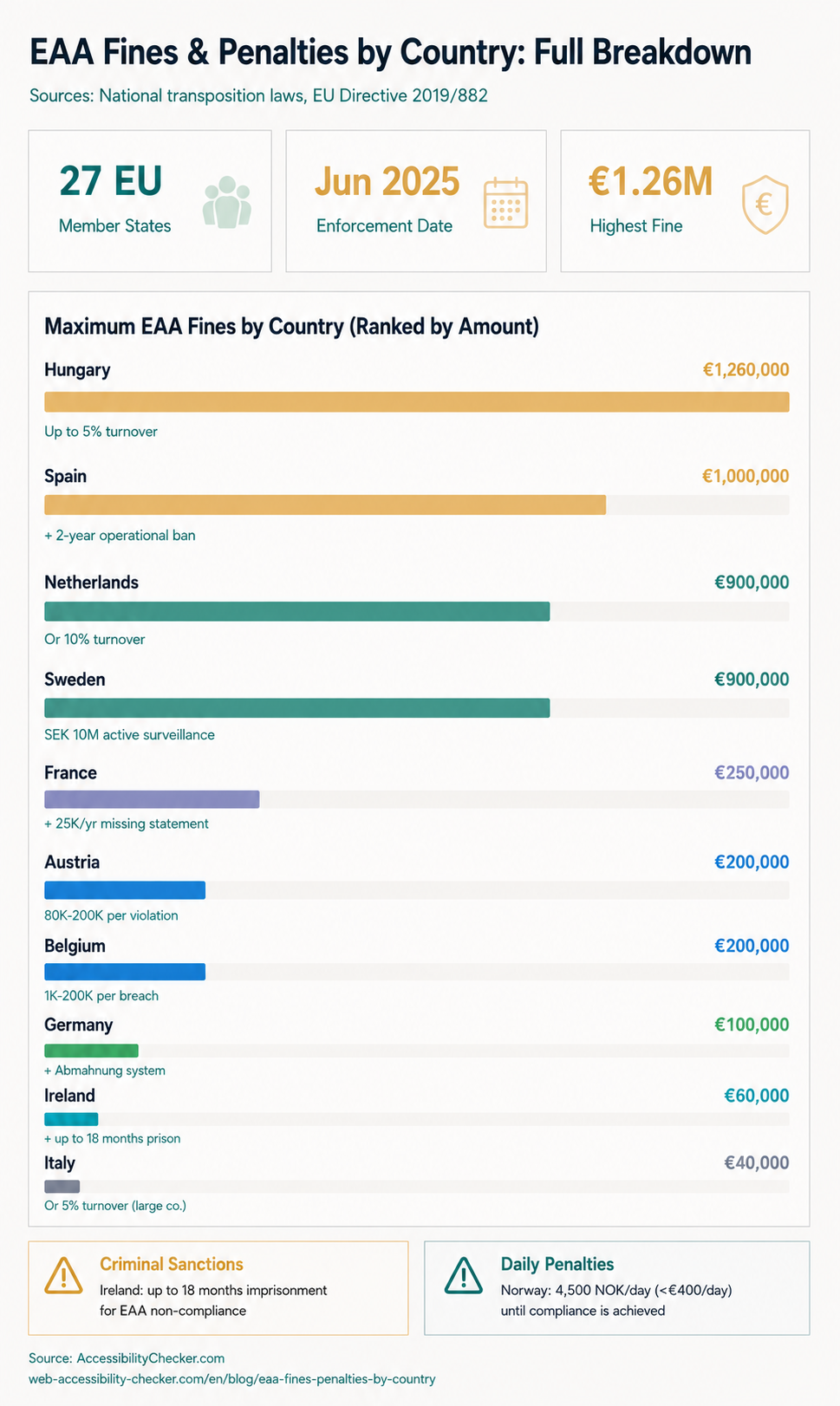
The risk on the other side is equally real: those who cannot certify accessibility may lose contracts and face restricted distribution. And the Act does not set a single sanctions regime at the European level; each member state determines its own penalties. Administrative fines generally range from €5,000 to €100,000, though some countries also allow daily penalties for ongoing non-compliance. Some figures are considerably higher. Spain allows fines of up to €1,000,000 plus operational bans of up to two years. Hungary sets penalties at up to 5% of turnover. The Netherlands can impose up to €900,000 or 10% of annual revenue. France applies fines of between €5,000 and €250,000, with additional annual penalties of €25,000 for lacking an accessibility statement.

And there is an important nuance worth noting: in Germany, the fine structure is per individual infringement. A site with 15 accessibility issues could theoretically face €1,500,000 in cumulative penalties.

The stakes are real: Have we incorporated accessibility and responsible AI use as sales arguments? Do we understand the consequences of not having our catalogs ready under current legislation?

5. Do We Have the Right Team and the Right Partners for This Journey?

Compliance with the European Accessibility Act and the AI Regulation is not a six-month project to be delegated to the legal department. It is a transformation that affects content architecture, technology systems, editorial processes, supplier contracts, and organizational culture. It requires people to simultaneously understand pedagogy, technology, the regulatory framework, and editorial operations.

‍Publishers that are navigating this moment well share four traits: they have a clear picture of where they stand today on accessibility and AI use; they have accepted that structured content is not optional in the long run; they maintain documented human editorial oversight over content generated with the help of AI tools; and they have started to see regulatory compliance as a competitive capability, one that takes time to build.

At EDT&Partners, we work alongside educational publishers through transformations of this scale: from digital maturity assessments to the design of structured content architectures and responsible AI strategies.

Which leaves us with one question: Do we have the combination of capabilities we need internally, or do we need to build strategic partnerships to avoid being left behind?

The Time to Act Is Now

Publishers that act today have a genuine advantage over those that wait for deadlines to become emergencies. Accessibility and transparency about AI use are not obstacles to creating good educational content. They are part of what it means to create better content.

If you'd like to explore how all of this applies to your organization, what your real starting point is and which steps offer the best return from there, we're available for an initial conversation. The first step doesn't have to be the biggest one – but it does have to be today.

About Ana Isabel Calvo

Ana Isabel Calvo is a specialist in digital transformation and AI applied to education and digital publishing. She is currently Director and Partner for LATAM and Europe at EDT&Partners.

With over 25 years of experience in EdTech, she served as Deputy Director of the Technical Department at Santillana Educación, leading innovation and digital transformation initiatives. She has advised companies and institutions on digital strategy, educational innovation, competency programs, teacher training, and acclaimed learning projects in both the private and public sectors.

She is the founder of the first EdTech consultancy created and led by a woman in Spain, recognized by INCYDE and the Norwegian Government.

Ana Isabel Calvo

Director & Partner, EMEA & LATAM, EDT&Partners

Ana is an EdTech leader with 20+ years of experience driving digital transformation and innovation throughout Spain and LATAM.

Get in touch

Join our newsletter

Be part of our global community — receive the latest articles, perspectives, and resources from The EDiT Journal.

AI & Accessibility Compliance: 5 Questions Every Publisher Needs to Answer Before the Deadline

Most publishers are treating this as a legal problem. It isn't. It's a content, technology, and strategy problem — and the ones who understand that first will have the advantage.

Ana Isabel Calvo

Director & Partner, EMEA & LATAM, EDT&Partners

calender-image
May 29, 2026
clock-image
5 min

Go to the Spanish version of this article.

Introduction: Two Regulations, One Urgent Reality

Two years ago, talking about the European Accessibility Act (EAA) or the EU Artificial Intelligence Regulation meant talking about the future. Today, that future has a date, and for many publishers, it has already arrived. The EAA is binding legislation: from June 28, 2025, all new products and services introduced to the EU market must meet its accessibility requirements. By 2030, compliance will be universal. And between those two milestones, the AI Act deploys its own demands: the transparency obligations of Article 50 — labeling of AI-generated content — come into force in August 2026.

For a Chief Content Officer or Chief Digital Officer at a publishing house, the question is not whether this affects them. The answer is yes, and it already does. The question is: where do we start, and how do we turn this challenge into an advantage? This article proposes five points that, in our experience, you should consider in order to address this obligation.

This article proposes five questions that, in our experience working with educational publishers globally, are the ones that actually matter.

1. Is Accessibility a Content Problem — Not Just a Legal One?

When legal teams present the requirements of the European Accessibility Act, the natural reaction is to treat it as a compliance matter: review with counsel, check the boxes, move on. That's understandable. It's also the path to failure — we have seen it play out at several companies.

‍This law cannot be resolved from the legal department because its roots are editorial and technical. Among the products it regulates are e-books and e-commerce: a publisher's digital catalog is not peripheral to this regulation, it is precisely its center. Backlist titles that cannot be made accessible could be withdrawn from the European market.

The sustainable solution is not retroactive remediation — fixing content title by title — but redesigning the workflow from the editorial flow. Structured content (EPUB 3, semantic HTML, component-based content management systems) is accessible by design, not by correction after the fact. This requires leadership from content and digital leadership, not just from the legal team.

The question to ask: Does our workflow produce accessibility as a natural output, or is it always a layer we add at the end?

2. Are We Developers or Users of AI?

The AI Regulation distinguishes between providers — those who develop an AI system and deploy it under their own name, whether to sell it, license it, or use it internally at scale — and deployers, those who use third-party systems in their professional operations. What matters is not who built the system, but who takes responsibility for putting it into service.

A publisher that integrates third-party AI tools into its editorial workflow is, in principle, a deployer. But that classification can change: if it substantially customizes those tools through fine-tuning, RAG with proprietary data, or specific behavioral instructions, or if it uses a general-purpose system for a specifically educational application, it shifts into the role of provider, with all the obligations that entails. And many organizations occupy both roles simultaneously, depending on the system in question.

There are three concrete consequences:

  • Labeling of AI-generated content: Article 50 requires disclosure when content is intended to inform the public, unless documented human editorial review has taken place.
  • Technical documentation: Providers of high-risk systems, and education is explicitly included in Annex III of the Regulation, will need to meet conformity requirements from December 2027.
  • Responsibility in the value chain: Transparency obligations must be distributed and contractually documented among whoever develops the model, whoever builds the system, and whoever publishes the content.

That said, have we formally assessed whether we are providers or deployers?

3. Can AI Help Us Comply Faster?

‍There is an apparent paradox: AI creates new regulatory burdens, but it may also be the most powerful tool available for managing compliance. For publishers with catalogs of thousands of titles lacking structural tags or image alt text, manual remediation is not feasible within the available timelines. With well-designed AI tools and human editorial supervision, it is.

‍Current tools can generate alt text for images, detect and prioritize accessibility issues, transform static content into structured formats, and continuously verify compliance with international web accessibility standards. Furthermore, Article 50 offers a meaningful exemption: if AI-assisted content has been reviewed and approved by a person with documented editorial responsibility, labeling is not required. This creates a genuine incentive to keep the editor at the center of the process.

If you are starting today, I would recommend:

  • Baseline diagnosis: What percentage of your active catalog meets web accessibility standards? Quantify the risk before designing the response.
  • Apply the "accessible from the source" principle to everything new. Don't wait until 2030.
  • Review your content management system: Can it produce accessible structure natively?
  • Clarify your role under the AI Regulation for each system you use or develop.
  • Formalize editorial review processes for AI-assisted content.

Which raises the important question: are we using AI to scale compliance?

4. How Does This Affect Our Competitive Position? What Are the Risks of Not Adapting Our Content?

Source: METIS Digital y  Accessibility

The European Commission itself points to the direct business benefits for companies that adopt the Accessibility Act: shared rules that reduce operational costs, easier cross-border trade, and expanded market opportunities. Accessibility is not just a compliance cost. It is a condition of access to the European internal market, and a genuine advantage for those who build it before their competitors do.

The market is substantial: approximately 87 million people in the EU have some form of disability. And institutional buyers, schools, universities, and public administrations, are beginning to include accessibility criteria and AI transparency requirements in their procurement processes. A publisher that can demonstrate proactive compliance has a concrete advantage in tenders and large accounts.

The risk on the other side is equally real: those who cannot certify accessibility may lose contracts and face restricted distribution. And the Act does not set a single sanctions regime at the European level; each member state determines its own penalties. Administrative fines generally range from €5,000 to €100,000, though some countries also allow daily penalties for ongoing non-compliance. Some figures are considerably higher. Spain allows fines of up to €1,000,000 plus operational bans of up to two years. Hungary sets penalties at up to 5% of turnover. The Netherlands can impose up to €900,000 or 10% of annual revenue. France applies fines of between €5,000 and €250,000, with additional annual penalties of €25,000 for lacking an accessibility statement.

And there is an important nuance worth noting: in Germany, the fine structure is per individual infringement. A site with 15 accessibility issues could theoretically face €1,500,000 in cumulative penalties.

The stakes are real: Have we incorporated accessibility and responsible AI use as sales arguments? Do we understand the consequences of not having our catalogs ready under current legislation?

5. Do We Have the Right Team and the Right Partners for This Journey?

Compliance with the European Accessibility Act and the AI Regulation is not a six-month project to be delegated to the legal department. It is a transformation that affects content architecture, technology systems, editorial processes, supplier contracts, and organizational culture. It requires people to simultaneously understand pedagogy, technology, the regulatory framework, and editorial operations.

‍Publishers that are navigating this moment well share four traits: they have a clear picture of where they stand today on accessibility and AI use; they have accepted that structured content is not optional in the long run; they maintain documented human editorial oversight over content generated with the help of AI tools; and they have started to see regulatory compliance as a competitive capability, one that takes time to build.

At EDT&Partners, we work alongside educational publishers through transformations of this scale: from digital maturity assessments to the design of structured content architectures and responsible AI strategies.

Which leaves us with one question: Do we have the combination of capabilities we need internally, or do we need to build strategic partnerships to avoid being left behind?

The Time to Act Is Now

Publishers that act today have a genuine advantage over those that wait for deadlines to become emergencies. Accessibility and transparency about AI use are not obstacles to creating good educational content. They are part of what it means to create better content.

If you'd like to explore how all of this applies to your organization, what your real starting point is and which steps offer the best return from there, we're available for an initial conversation. The first step doesn't have to be the biggest one – but it does have to be today.

About Ana Isabel Calvo

Ana Isabel Calvo is a specialist in digital transformation and AI applied to education and digital publishing. She is currently Director and Partner for LATAM and Europe at EDT&Partners.

With over 25 years of experience in EdTech, she served as Deputy Director of the Technical Department at Santillana Educación, leading innovation and digital transformation initiatives. She has advised companies and institutions on digital strategy, educational innovation, competency programs, teacher training, and acclaimed learning projects in both the private and public sectors.

She is the founder of the first EdTech consultancy created and led by a woman in Spain, recognized by INCYDE and the Norwegian Government.

Ana Isabel Calvo

Director & Partner, EMEA & LATAM, EDT&Partners

Ana is an EdTech leader with 20+ years of experience driving digital transformation and innovation throughout Spain and LATAM.

Get in touch

Join our newsletter

Be part of our global community — receive the latest articles, perspectives, and resources from The EDiT Journal.

AI & Accessibility Compliance: 5 Questions Every Publisher Needs to Answer Before the Deadline

Most publishers are treating this as a legal problem. It isn't. It's a content, technology, and strategy problem — and the ones who understand that first will have the advantage.

Ana Isabel Calvo

Director & Partner, EMEA & LATAM, EDT&Partners

Ana is an EdTech leader with 20+ years of experience driving digital transformation and innovation throughout Spain and LATAM.

calender-image
May 29, 2026
clock-image
5 min

Go to the Spanish version of this article.

Introduction: Two Regulations, One Urgent Reality

Two years ago, talking about the European Accessibility Act (EAA) or the EU Artificial Intelligence Regulation meant talking about the future. Today, that future has a date, and for many publishers, it has already arrived. The EAA is binding legislation: from June 28, 2025, all new products and services introduced to the EU market must meet its accessibility requirements. By 2030, compliance will be universal. And between those two milestones, the AI Act deploys its own demands: the transparency obligations of Article 50 — labeling of AI-generated content — come into force in August 2026.

For a Chief Content Officer or Chief Digital Officer at a publishing house, the question is not whether this affects them. The answer is yes, and it already does. The question is: where do we start, and how do we turn this challenge into an advantage? This article proposes five points that, in our experience, you should consider in order to address this obligation.

This article proposes five questions that, in our experience working with educational publishers globally, are the ones that actually matter.

1. Is Accessibility a Content Problem — Not Just a Legal One?

When legal teams present the requirements of the European Accessibility Act, the natural reaction is to treat it as a compliance matter: review with counsel, check the boxes, move on. That's understandable. It's also the path to failure — we have seen it play out at several companies.

‍This law cannot be resolved from the legal department because its roots are editorial and technical. Among the products it regulates are e-books and e-commerce: a publisher's digital catalog is not peripheral to this regulation, it is precisely its center. Backlist titles that cannot be made accessible could be withdrawn from the European market.

The sustainable solution is not retroactive remediation — fixing content title by title — but redesigning the workflow from the editorial flow. Structured content (EPUB 3, semantic HTML, component-based content management systems) is accessible by design, not by correction after the fact. This requires leadership from content and digital leadership, not just from the legal team.

The question to ask: Does our workflow produce accessibility as a natural output, or is it always a layer we add at the end?

2. Are We Developers or Users of AI?

The AI Regulation distinguishes between providers — those who develop an AI system and deploy it under their own name, whether to sell it, license it, or use it internally at scale — and deployers, those who use third-party systems in their professional operations. What matters is not who built the system, but who takes responsibility for putting it into service.

A publisher that integrates third-party AI tools into its editorial workflow is, in principle, a deployer. But that classification can change: if it substantially customizes those tools through fine-tuning, RAG with proprietary data, or specific behavioral instructions, or if it uses a general-purpose system for a specifically educational application, it shifts into the role of provider, with all the obligations that entails. And many organizations occupy both roles simultaneously, depending on the system in question.

There are three concrete consequences:

  • Labeling of AI-generated content: Article 50 requires disclosure when content is intended to inform the public, unless documented human editorial review has taken place.
  • Technical documentation: Providers of high-risk systems, and education is explicitly included in Annex III of the Regulation, will need to meet conformity requirements from December 2027.
  • Responsibility in the value chain: Transparency obligations must be distributed and contractually documented among whoever develops the model, whoever builds the system, and whoever publishes the content.

That said, have we formally assessed whether we are providers or deployers?

3. Can AI Help Us Comply Faster?

‍There is an apparent paradox: AI creates new regulatory burdens, but it may also be the most powerful tool available for managing compliance. For publishers with catalogs of thousands of titles lacking structural tags or image alt text, manual remediation is not feasible within the available timelines. With well-designed AI tools and human editorial supervision, it is.

‍Current tools can generate alt text for images, detect and prioritize accessibility issues, transform static content into structured formats, and continuously verify compliance with international web accessibility standards. Furthermore, Article 50 offers a meaningful exemption: if AI-assisted content has been reviewed and approved by a person with documented editorial responsibility, labeling is not required. This creates a genuine incentive to keep the editor at the center of the process.

If you are starting today, I would recommend:

  • Baseline diagnosis: What percentage of your active catalog meets web accessibility standards? Quantify the risk before designing the response.
  • Apply the "accessible from the source" principle to everything new. Don't wait until 2030.
  • Review your content management system: Can it produce accessible structure natively?
  • Clarify your role under the AI Regulation for each system you use or develop.
  • Formalize editorial review processes for AI-assisted content.

Which raises the important question: are we using AI to scale compliance?

4. How Does This Affect Our Competitive Position? What Are the Risks of Not Adapting Our Content?

Source: METIS Digital y  Accessibility

The European Commission itself points to the direct business benefits for companies that adopt the Accessibility Act: shared rules that reduce operational costs, easier cross-border trade, and expanded market opportunities. Accessibility is not just a compliance cost. It is a condition of access to the European internal market, and a genuine advantage for those who build it before their competitors do.

The market is substantial: approximately 87 million people in the EU have some form of disability. And institutional buyers, schools, universities, and public administrations, are beginning to include accessibility criteria and AI transparency requirements in their procurement processes. A publisher that can demonstrate proactive compliance has a concrete advantage in tenders and large accounts.

The risk on the other side is equally real: those who cannot certify accessibility may lose contracts and face restricted distribution. And the Act does not set a single sanctions regime at the European level; each member state determines its own penalties. Administrative fines generally range from €5,000 to €100,000, though some countries also allow daily penalties for ongoing non-compliance. Some figures are considerably higher. Spain allows fines of up to €1,000,000 plus operational bans of up to two years. Hungary sets penalties at up to 5% of turnover. The Netherlands can impose up to €900,000 or 10% of annual revenue. France applies fines of between €5,000 and €250,000, with additional annual penalties of €25,000 for lacking an accessibility statement.

And there is an important nuance worth noting: in Germany, the fine structure is per individual infringement. A site with 15 accessibility issues could theoretically face €1,500,000 in cumulative penalties.

The stakes are real: Have we incorporated accessibility and responsible AI use as sales arguments? Do we understand the consequences of not having our catalogs ready under current legislation?

5. Do We Have the Right Team and the Right Partners for This Journey?

Compliance with the European Accessibility Act and the AI Regulation is not a six-month project to be delegated to the legal department. It is a transformation that affects content architecture, technology systems, editorial processes, supplier contracts, and organizational culture. It requires people to simultaneously understand pedagogy, technology, the regulatory framework, and editorial operations.

‍Publishers that are navigating this moment well share four traits: they have a clear picture of where they stand today on accessibility and AI use; they have accepted that structured content is not optional in the long run; they maintain documented human editorial oversight over content generated with the help of AI tools; and they have started to see regulatory compliance as a competitive capability, one that takes time to build.

At EDT&Partners, we work alongside educational publishers through transformations of this scale: from digital maturity assessments to the design of structured content architectures and responsible AI strategies.

Which leaves us with one question: Do we have the combination of capabilities we need internally, or do we need to build strategic partnerships to avoid being left behind?

The Time to Act Is Now

Publishers that act today have a genuine advantage over those that wait for deadlines to become emergencies. Accessibility and transparency about AI use are not obstacles to creating good educational content. They are part of what it means to create better content.

If you'd like to explore how all of this applies to your organization, what your real starting point is and which steps offer the best return from there, we're available for an initial conversation. The first step doesn't have to be the biggest one – but it does have to be today.

About Ana Isabel Calvo

Ana Isabel Calvo is a specialist in digital transformation and AI applied to education and digital publishing. She is currently Director and Partner for LATAM and Europe at EDT&Partners.

With over 25 years of experience in EdTech, she served as Deputy Director of the Technical Department at Santillana Educación, leading innovation and digital transformation initiatives. She has advised companies and institutions on digital strategy, educational innovation, competency programs, teacher training, and acclaimed learning projects in both the private and public sectors.

She is the founder of the first EdTech consultancy created and led by a woman in Spain, recognized by INCYDE and the Norwegian Government.

Ana Isabel Calvo

Director & Partner, EMEA & LATAM, EDT&Partners

Ana is an EdTech leader with 20+ years of experience driving digital transformation and innovation throughout Spain and LATAM.

Get in touch

Join our newsletter

Be part of our global community — receive the latest articles, perspectives, and resources from The EDiT Journal.