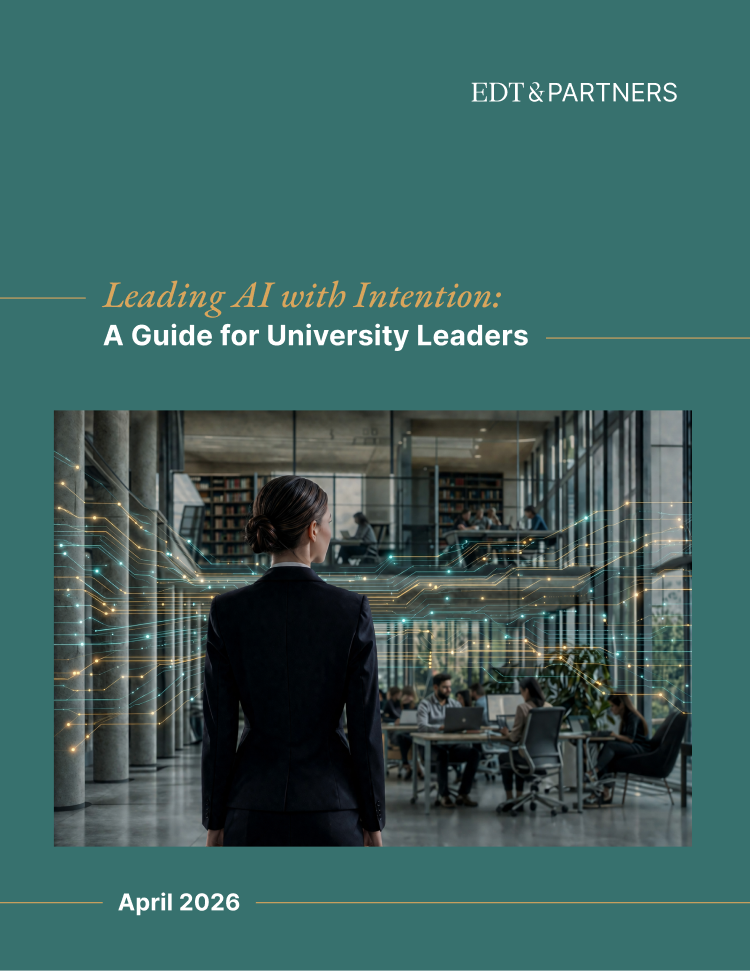
Report. Leading AI with Intention: A Guide for University Leaders

How university leaders can move from fragmented AI adoption to intentional institutional design. A Report by EDT&Partners.

EDT&Partners

calender-image
April 15, 2026
clock-image
15 min

Artificial intelligence is already embedded across higher education, shaping how students learn, how faculty teach, and how institutions operate. The question facing university leaders is no longer whether AI will transform their institution, but whether they will shape how that transformation unfolds.

Leading AI with Intention: A Guide for University Leaders explores how institutions can move beyond fragmented, uncoordinated AI adoption toward a more deliberate and structured approach. As AI becomes ambient infrastructure across teaching, research, and operations, the challenge is not adoption, but visibility, coherence, and institutional design.

This report reframes AI not as a tool or innovation layer, but as a core institutional capability. It examines how universities can build the conditions for AI to be used effectively and responsibly, ensuring that its benefits extend across the entire institution, not just isolated teams or early adopters.

At its core, this is a leadership question. The institutions navigating this moment most successfully are not those moving fastest or most cautiously, but those acting with intention, aligning technology, people, and governance around a shared vision for the future.

Content in the report

  • Executive Summary
  • From Experimentation to Infrastructure
  • What an AI Management System (AIMS) Makes Possible
  • AI Stewardship and Governance Models
  • Designing the AI-Native University
  • Leading with Intention: A Reflection for University Leaders

Executive Summary

Artificial intelligence is no longer something universities are deciding whether to adopt. It is already here: in the learning management system, the advising platform, the research pipeline, the plagiarism detector. It is in the productivity software that everyone who touches a computer uses for daily tasks, from mundane to complex. The question facing university leaders is not whether AI will transform their institution, but whether they will shape how that transformation unfolds.

The scale of what is already happening is significant. Over 90% of students and staff now use AI tools daily, and institutional adoption has increased sharply in a single year. Yet much of this growth is occurring through individual use, local experimentation, and point solutions rather than deliberate institutional design. AI is becoming ambient infrastructure as it accumulates across systems and practices that now structure institutional life.

This is not solely a technology or compliance question. It is, above all, a leadership question about what kind of institution you will become in light of such rapid technological change. Rather than operating with the greatest caution or fastest speed, the universities successfully navigating this moment are those that have been most intentional.

This paper makes a simple argument: that AI should be considered institutional infrastructure, and managing it well requires visibility, shared capability, and people genuinely at the center. Doing so will create conditions for the whole institution to benefit, not just the departments that have already embraced AI, but every student, educator, and staff member the institution serves.

Three things that distinguish institutions leading on AI:
  • They know where AI is operating, and use that visibility to build on what's working, not just manage what's risky.
    • Proactively monitor shadow AI and provide both application and network-level guardrails and institutional governance.
  • They build shared capability, so AI use compounds across the institution rather than staying siloed in departments.
    • Think multi-stakeholder project-based AI use cases, libraries of prompts and quick prototype validation.
  • They keep people at the center, ensuring that human judgment, not algorithmic output, drives the decisions that matter most.
    • Different forms of human-in-the-loop design are embedded in both the technology and the decision-making process. Innovation is not measured on time saved or output but quality, outcomes and differentiation.

From Experimentation to Infrastructure

AI is Already Here

Three years after generative AI entered mainstream awareness, the question for universities is no longer whether AI will be adopted. It already has been adopted widely, rapidly, and largely organically. Coursera's 2026 global study found over 95% of students and educators use AI in educational contexts. On the staff side, 90% of higher education professionals now use AI, and institutional adoption jumped 17 percentage points in a single year.

AI represents an infrastructure shift as significant, in its way, as the arrival of the internet or cloud computing. AI is now woven into how students learn, how faculty teach, and how institutions operate. It is embedded in the learning management system (LMS), the email system, the advising platform, and the research pipeline. Like electricity or Wi-Fi, it is ambient infrastructure, present whether or not institutions have explicitly chosen to deploy it.

The opportunity at this moment is considerable. Institutions that understand where AI is operating, and that create the conditions for it to be used well and responsibly, are positioned to deliver meaningfully better outcomes for students, faculty, and staff. The institutions best positioned to seize that opportunity are those that get ahead of it, not by slowing adoption but by making it coherent.

The Visibility Challenges

The primary challenge is not adoption. It is that so much adoption is currently invisible to the institution. Over 56% of higher education workers use shadow AI, or tools acquired outside institutional knowledge or review. Meanwhile, vendors are embedding AI capabilities into products universities already own, often without disclosure. And the rapid proliferation of AI across organizational functions —  called agent sprawl — means that even well-intentioned institutions can find themselves with duplicated capabilities, inconsistent data handling, and no single point of accountability. 

The consequences are not theoretical. In higher education, where institutions hold vast quantities of student data protected by Family Educational Rights and Privacy Act (FERPA) and equivalent regulations, fragmented AI adoption creates specific risks: regulatory liability, vendor relationships that have outpaced contract terms, and inconsistent experiences for students depending on which department or classroom they happen to be in.

None of this is cause for alarm, but it is cause for intention. The institutions navigating this well are not the ones that have slowed AI adoption. They are the ones that have made it legible, coordinated, and purposeful.

To keep reading, please download the report.

EDT&Partners

The EDT&Partners Editorial Team brings together education and technology experts sharing insights, stories, and strategies shaping the future of learning.

Get in touch

Join our newsletter

Be part of our global community — receive the latest articles, perspectives, and resources from The EDiT Journal.

Report. Leading AI with Intention: A Guide for University Leaders

How university leaders can move from fragmented AI adoption to intentional institutional design. A Report by EDT&Partners.

EDT&Partners

The EDT&Partners Editorial Team brings together education and technology experts sharing insights, stories, and strategies shaping the future of learning.

calender-image
April 15, 2026
clock-image
15 min

Artificial intelligence is already embedded across higher education, shaping how students learn, how faculty teach, and how institutions operate. The question facing university leaders is no longer whether AI will transform their institution, but whether they will shape how that transformation unfolds.

Leading AI with Intention: A Guide for University Leaders explores how institutions can move beyond fragmented, uncoordinated AI adoption toward a more deliberate and structured approach. As AI becomes ambient infrastructure across teaching, research, and operations, the challenge is not adoption, but visibility, coherence, and institutional design.

This report reframes AI not as a tool or innovation layer, but as a core institutional capability. It examines how universities can build the conditions for AI to be used effectively and responsibly, ensuring that its benefits extend across the entire institution, not just isolated teams or early adopters.

At its core, this is a leadership question. The institutions navigating this moment most successfully are not those moving fastest or most cautiously, but those acting with intention, aligning technology, people, and governance around a shared vision for the future.

Content in the report

  • Executive Summary
  • From Experimentation to Infrastructure
  • What an AI Management System (AIMS) Makes Possible
  • AI Stewardship and Governance Models
  • Designing the AI-Native University
  • Leading with Intention: A Reflection for University Leaders

Executive Summary

Artificial intelligence is no longer something universities are deciding whether to adopt. It is already here: in the learning management system, the advising platform, the research pipeline, the plagiarism detector. It is in the productivity software that everyone who touches a computer uses for daily tasks, from mundane to complex. The question facing university leaders is not whether AI will transform their institution, but whether they will shape how that transformation unfolds.

The scale of what is already happening is significant. Over 90% of students and staff now use AI tools daily, and institutional adoption has increased sharply in a single year. Yet much of this growth is occurring through individual use, local experimentation, and point solutions rather than deliberate institutional design. AI is becoming ambient infrastructure as it accumulates across systems and practices that now structure institutional life.

This is not solely a technology or compliance question. It is, above all, a leadership question about what kind of institution you will become in light of such rapid technological change. Rather than operating with the greatest caution or fastest speed, the universities successfully navigating this moment are those that have been most intentional.

This paper makes a simple argument: that AI should be considered institutional infrastructure, and managing it well requires visibility, shared capability, and people genuinely at the center. Doing so will create conditions for the whole institution to benefit, not just the departments that have already embraced AI, but every student, educator, and staff member the institution serves.

Three things that distinguish institutions leading on AI:
  • They know where AI is operating, and use that visibility to build on what's working, not just manage what's risky.
    • Proactively monitor shadow AI and provide both application and network-level guardrails and institutional governance.
  • They build shared capability, so AI use compounds across the institution rather than staying siloed in departments.
    • Think multi-stakeholder project-based AI use cases, libraries of prompts and quick prototype validation.
  • They keep people at the center, ensuring that human judgment, not algorithmic output, drives the decisions that matter most.
    • Different forms of human-in-the-loop design are embedded in both the technology and the decision-making process. Innovation is not measured on time saved or output but quality, outcomes and differentiation.

From Experimentation to Infrastructure

AI is Already Here

Three years after generative AI entered mainstream awareness, the question for universities is no longer whether AI will be adopted. It already has been adopted widely, rapidly, and largely organically. Coursera's 2026 global study found over 95% of students and educators use AI in educational contexts. On the staff side, 90% of higher education professionals now use AI, and institutional adoption jumped 17 percentage points in a single year.

AI represents an infrastructure shift as significant, in its way, as the arrival of the internet or cloud computing. AI is now woven into how students learn, how faculty teach, and how institutions operate. It is embedded in the learning management system (LMS), the email system, the advising platform, and the research pipeline. Like electricity or Wi-Fi, it is ambient infrastructure, present whether or not institutions have explicitly chosen to deploy it.

The opportunity at this moment is considerable. Institutions that understand where AI is operating, and that create the conditions for it to be used well and responsibly, are positioned to deliver meaningfully better outcomes for students, faculty, and staff. The institutions best positioned to seize that opportunity are those that get ahead of it, not by slowing adoption but by making it coherent.

The Visibility Challenges

The primary challenge is not adoption. It is that so much adoption is currently invisible to the institution. Over 56% of higher education workers use shadow AI, or tools acquired outside institutional knowledge or review. Meanwhile, vendors are embedding AI capabilities into products universities already own, often without disclosure. And the rapid proliferation of AI across organizational functions —  called agent sprawl — means that even well-intentioned institutions can find themselves with duplicated capabilities, inconsistent data handling, and no single point of accountability. 

The consequences are not theoretical. In higher education, where institutions hold vast quantities of student data protected by Family Educational Rights and Privacy Act (FERPA) and equivalent regulations, fragmented AI adoption creates specific risks: regulatory liability, vendor relationships that have outpaced contract terms, and inconsistent experiences for students depending on which department or classroom they happen to be in.

None of this is cause for alarm, but it is cause for intention. The institutions navigating this well are not the ones that have slowed AI adoption. They are the ones that have made it legible, coordinated, and purposeful.

To keep reading, please download the report.

EDT&Partners

The EDT&Partners Editorial Team brings together education and technology experts sharing insights, stories, and strategies shaping the future of learning.

Get in touch

Join our newsletter

Be part of our global community — receive the latest articles, perspectives, and resources from The EDiT Journal.

Report. Leading AI with Intention: A Guide for University Leaders

How university leaders can move from fragmented AI adoption to intentional institutional design. A Report by EDT&Partners.

EDT&Partners

calender-image
April 15, 2026
clock-image
15 min

Artificial intelligence is already embedded across higher education, shaping how students learn, how faculty teach, and how institutions operate. The question facing university leaders is no longer whether AI will transform their institution, but whether they will shape how that transformation unfolds.

Leading AI with Intention: A Guide for University Leaders explores how institutions can move beyond fragmented, uncoordinated AI adoption toward a more deliberate and structured approach. As AI becomes ambient infrastructure across teaching, research, and operations, the challenge is not adoption, but visibility, coherence, and institutional design.

This report reframes AI not as a tool or innovation layer, but as a core institutional capability. It examines how universities can build the conditions for AI to be used effectively and responsibly, ensuring that its benefits extend across the entire institution, not just isolated teams or early adopters.

At its core, this is a leadership question. The institutions navigating this moment most successfully are not those moving fastest or most cautiously, but those acting with intention, aligning technology, people, and governance around a shared vision for the future.

Content in the report

  • Executive Summary
  • From Experimentation to Infrastructure
  • What an AI Management System (AIMS) Makes Possible
  • AI Stewardship and Governance Models
  • Designing the AI-Native University
  • Leading with Intention: A Reflection for University Leaders

Executive Summary

Artificial intelligence is no longer something universities are deciding whether to adopt. It is already here: in the learning management system, the advising platform, the research pipeline, the plagiarism detector. It is in the productivity software that everyone who touches a computer uses for daily tasks, from mundane to complex. The question facing university leaders is not whether AI will transform their institution, but whether they will shape how that transformation unfolds.

The scale of what is already happening is significant. Over 90% of students and staff now use AI tools daily, and institutional adoption has increased sharply in a single year. Yet much of this growth is occurring through individual use, local experimentation, and point solutions rather than deliberate institutional design. AI is becoming ambient infrastructure as it accumulates across systems and practices that now structure institutional life.

This is not solely a technology or compliance question. It is, above all, a leadership question about what kind of institution you will become in light of such rapid technological change. Rather than operating with the greatest caution or fastest speed, the universities successfully navigating this moment are those that have been most intentional.

This paper makes a simple argument: that AI should be considered institutional infrastructure, and managing it well requires visibility, shared capability, and people genuinely at the center. Doing so will create conditions for the whole institution to benefit, not just the departments that have already embraced AI, but every student, educator, and staff member the institution serves.

Three things that distinguish institutions leading on AI:
  • They know where AI is operating, and use that visibility to build on what's working, not just manage what's risky.
    • Proactively monitor shadow AI and provide both application and network-level guardrails and institutional governance.
  • They build shared capability, so AI use compounds across the institution rather than staying siloed in departments.
    • Think multi-stakeholder project-based AI use cases, libraries of prompts and quick prototype validation.
  • They keep people at the center, ensuring that human judgment, not algorithmic output, drives the decisions that matter most.
    • Different forms of human-in-the-loop design are embedded in both the technology and the decision-making process. Innovation is not measured on time saved or output but quality, outcomes and differentiation.

From Experimentation to Infrastructure

AI is Already Here

Three years after generative AI entered mainstream awareness, the question for universities is no longer whether AI will be adopted. It already has been adopted widely, rapidly, and largely organically. Coursera's 2026 global study found over 95% of students and educators use AI in educational contexts. On the staff side, 90% of higher education professionals now use AI, and institutional adoption jumped 17 percentage points in a single year.

AI represents an infrastructure shift as significant, in its way, as the arrival of the internet or cloud computing. AI is now woven into how students learn, how faculty teach, and how institutions operate. It is embedded in the learning management system (LMS), the email system, the advising platform, and the research pipeline. Like electricity or Wi-Fi, it is ambient infrastructure, present whether or not institutions have explicitly chosen to deploy it.

The opportunity at this moment is considerable. Institutions that understand where AI is operating, and that create the conditions for it to be used well and responsibly, are positioned to deliver meaningfully better outcomes for students, faculty, and staff. The institutions best positioned to seize that opportunity are those that get ahead of it, not by slowing adoption but by making it coherent.

The Visibility Challenges

The primary challenge is not adoption. It is that so much adoption is currently invisible to the institution. Over 56% of higher education workers use shadow AI, or tools acquired outside institutional knowledge or review. Meanwhile, vendors are embedding AI capabilities into products universities already own, often without disclosure. And the rapid proliferation of AI across organizational functions —  called agent sprawl — means that even well-intentioned institutions can find themselves with duplicated capabilities, inconsistent data handling, and no single point of accountability. 

The consequences are not theoretical. In higher education, where institutions hold vast quantities of student data protected by Family Educational Rights and Privacy Act (FERPA) and equivalent regulations, fragmented AI adoption creates specific risks: regulatory liability, vendor relationships that have outpaced contract terms, and inconsistent experiences for students depending on which department or classroom they happen to be in.

None of this is cause for alarm, but it is cause for intention. The institutions navigating this well are not the ones that have slowed AI adoption. They are the ones that have made it legible, coordinated, and purposeful.

To keep reading, please download the report.

EDT&Partners

The EDT&Partners Editorial Team brings together education and technology experts sharing insights, stories, and strategies shaping the future of learning.

Get in touch

Join our newsletter

Be part of our global community — receive the latest articles, perspectives, and resources from The EDiT Journal.

Report. Leading AI with Intention: A Guide for University Leaders

How university leaders can move from fragmented AI adoption to intentional institutional design. A Report by EDT&Partners.

EDT&Partners

The EDT&Partners Editorial Team brings together education and technology experts sharing insights, stories, and strategies shaping the future of learning.

calender-image
April 15, 2026
clock-image
15 min

Artificial intelligence is already embedded across higher education, shaping how students learn, how faculty teach, and how institutions operate. The question facing university leaders is no longer whether AI will transform their institution, but whether they will shape how that transformation unfolds.

Leading AI with Intention: A Guide for University Leaders explores how institutions can move beyond fragmented, uncoordinated AI adoption toward a more deliberate and structured approach. As AI becomes ambient infrastructure across teaching, research, and operations, the challenge is not adoption, but visibility, coherence, and institutional design.

This report reframes AI not as a tool or innovation layer, but as a core institutional capability. It examines how universities can build the conditions for AI to be used effectively and responsibly, ensuring that its benefits extend across the entire institution, not just isolated teams or early adopters.

At its core, this is a leadership question. The institutions navigating this moment most successfully are not those moving fastest or most cautiously, but those acting with intention, aligning technology, people, and governance around a shared vision for the future.

Content in the report

  • Executive Summary
  • From Experimentation to Infrastructure
  • What an AI Management System (AIMS) Makes Possible
  • AI Stewardship and Governance Models
  • Designing the AI-Native University
  • Leading with Intention: A Reflection for University Leaders

Executive Summary

Artificial intelligence is no longer something universities are deciding whether to adopt. It is already here: in the learning management system, the advising platform, the research pipeline, the plagiarism detector. It is in the productivity software that everyone who touches a computer uses for daily tasks, from mundane to complex. The question facing university leaders is not whether AI will transform their institution, but whether they will shape how that transformation unfolds.

The scale of what is already happening is significant. Over 90% of students and staff now use AI tools daily, and institutional adoption has increased sharply in a single year. Yet much of this growth is occurring through individual use, local experimentation, and point solutions rather than deliberate institutional design. AI is becoming ambient infrastructure as it accumulates across systems and practices that now structure institutional life.

This is not solely a technology or compliance question. It is, above all, a leadership question about what kind of institution you will become in light of such rapid technological change. Rather than operating with the greatest caution or fastest speed, the universities successfully navigating this moment are those that have been most intentional.

This paper makes a simple argument: that AI should be considered institutional infrastructure, and managing it well requires visibility, shared capability, and people genuinely at the center. Doing so will create conditions for the whole institution to benefit, not just the departments that have already embraced AI, but every student, educator, and staff member the institution serves.

Three things that distinguish institutions leading on AI:
  • They know where AI is operating, and use that visibility to build on what's working, not just manage what's risky.
    • Proactively monitor shadow AI and provide both application and network-level guardrails and institutional governance.
  • They build shared capability, so AI use compounds across the institution rather than staying siloed in departments.
    • Think multi-stakeholder project-based AI use cases, libraries of prompts and quick prototype validation.
  • They keep people at the center, ensuring that human judgment, not algorithmic output, drives the decisions that matter most.
    • Different forms of human-in-the-loop design are embedded in both the technology and the decision-making process. Innovation is not measured on time saved or output but quality, outcomes and differentiation.

From Experimentation to Infrastructure

AI is Already Here

Three years after generative AI entered mainstream awareness, the question for universities is no longer whether AI will be adopted. It already has been adopted widely, rapidly, and largely organically. Coursera's 2026 global study found over 95% of students and educators use AI in educational contexts. On the staff side, 90% of higher education professionals now use AI, and institutional adoption jumped 17 percentage points in a single year.

AI represents an infrastructure shift as significant, in its way, as the arrival of the internet or cloud computing. AI is now woven into how students learn, how faculty teach, and how institutions operate. It is embedded in the learning management system (LMS), the email system, the advising platform, and the research pipeline. Like electricity or Wi-Fi, it is ambient infrastructure, present whether or not institutions have explicitly chosen to deploy it.

The opportunity at this moment is considerable. Institutions that understand where AI is operating, and that create the conditions for it to be used well and responsibly, are positioned to deliver meaningfully better outcomes for students, faculty, and staff. The institutions best positioned to seize that opportunity are those that get ahead of it, not by slowing adoption but by making it coherent.

If you’re thinking about what this means for your institution, we’d welcome the conversation.

Speak with our team about how to move from AI adoption to intentional institutional design.

Get in touch

The Visibility Challenges

The primary challenge is not adoption. It is that so much adoption is currently invisible to the institution. Over 56% of higher education workers use shadow AI, or tools acquired outside institutional knowledge or review. Meanwhile, vendors are embedding AI capabilities into products universities already own, often without disclosure. And the rapid proliferation of AI across organizational functions —  called agent sprawl — means that even well-intentioned institutions can find themselves with duplicated capabilities, inconsistent data handling, and no single point of accountability. 

The consequences are not theoretical. In higher education, where institutions hold vast quantities of student data protected by Family Educational Rights and Privacy Act (FERPA) and equivalent regulations, fragmented AI adoption creates specific risks: regulatory liability, vendor relationships that have outpaced contract terms, and inconsistent experiences for students depending on which department or classroom they happen to be in.

None of this is cause for alarm, but it is cause for intention. The institutions navigating this well are not the ones that have slowed AI adoption. They are the ones that have made it legible, coordinated, and purposeful.

To keep reading, please download the report.

EDT&Partners

The EDT&Partners Editorial Team brings together education and technology experts sharing insights, stories, and strategies shaping the future of learning.

Get in touch

Join our newsletter

Be part of our global community — receive the latest articles, perspectives, and resources from The EDiT Journal.