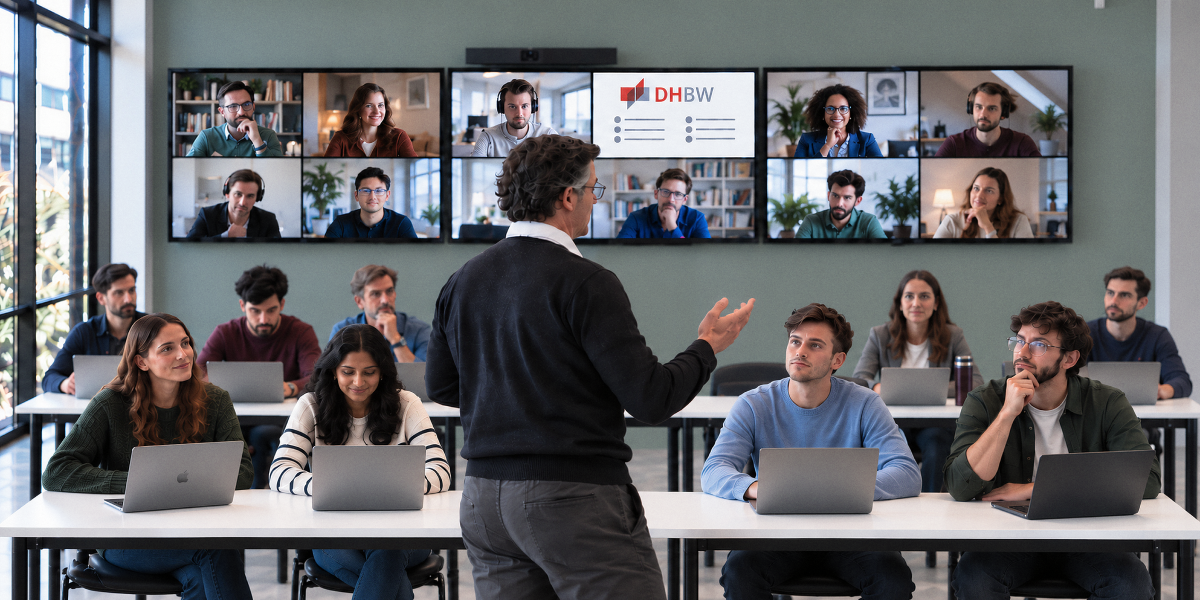
Duale Hochschule Baden-Württemberg (DHBW) is a cooperative state university in Germany, one of the country's largest bachelor-granting institutions, with over 33,000 students across more than nine locations in Baden-Württemberg. Its model is distinctive: students alternate between three-month study periods and three-month placements with their employing companies, earning a bachelor's degree alongside substantial real-world experience.
Prof. Kay Berkling, PhD, Professor of Computer Science, and her colleagues, Konstanze Alex, PhD, Digitalization Camp Project Lead, and Hui Li, Project Team Member, share their experience of transforming DHBW's campuses into connected hybrid learning environments in collaboration with EDT&Partners.
From COVID Workaround to Intentional Design
Prof. Kay Berkling: What makes DHBW special has always been the small, in-person cohort. You have around thirty students who go through their three years together: it's intimate, it's focused, and it's our unique selling proposition as a university. So moving to a hybrid model was a genuine step away from what we consider our best practice.
The push came during COVID. We had women who were pregnant and still able to finish their courses because we were offering everything remotely. We had students who were ill, students with caretaking responsibilities. Hybrid teaching meant they didn't have to fall behind. We learned a lot during that time. And when it was over, we didn't want to lose what we'd learned. We want to design something that works, not an ad hoc approach.
So we applied for an innovation grant from a Germany-wide funding institution for projects that innovate teaching, which is called Freiraum, meaning "free space" to explore. And we started looking for a partner.
Konstanze Alex: Before we found the right partner, we explored many ideas. We looked at remote-presence robots that could move around the classroom so the remote student would feel physically present. We considered VR glasses. We looked at reconfigurable furniture. Every idea ran into the same problems: too expensive, too complicated, and with limited actual gain. There was a real risk of exhausting the grant before achieving anything of substance.
Working with EDT&Partners
Prof. Kay Berkling: We found EDT&Partners at an EdTech conference. A university was on a panel discussion, clearly very happy with their hybrid classrooms — everything was working, it was fantastic. After they came off the stage, I walked straight over and asked, "Who implemented your setup?" Because they obviously knew what they were doing. That's where EDT&Partners' name came up.
What impressed us from the first conversation was that they had actually done it. Not proposed it, done it. They had implemented rooms that worked, and they could show us. Choosing EDT&Partners was a clear, doubt-free decision.
Konstanze Alex: What we also really appreciated from the beginning was the international composition of the EDT&Partners team, including colleagues from South America, Asia, and the Middle East. For us, that wasn't just an interesting background; it was directly relevant to where we want to take this project. The long-term vision is international virtual mobility, and working with a team that already thinks internationally gives us a lot of confidence.
I also appreciated the willingness to learn together. There were so many aspects where we climbed the ladder together and came out with something we didn't even expect.
Hui Li: At the impressive first meeting, you described how the technology, software, hardware, and targets would be perfectly packed together. Hussein Ayoub, Director MEA at EDT&Partners, is a very good, responsible, responsive, and flexible project manager. That was a key factor in the successful collaboration.
Teaching as One: Making the Right Decisions
Prof. Kay Berkling: Our hybrid philosophy is "Teaching as One." We had a lot of ideas to make it happen, some more expensive than others. One of the most important pieces of advice we got from EDT&Partners was to stop chasing the next shiny hardware. The VR glasses, for example, the minute you buy them, the technology is already outdated, and the actual gain is limited. The remote robots had practical problems: where to store them, who recharges their batteries, and what happens when they get stolen or break? The EDT&Partners team said: move away from all of that. Focus on a completely integrated solution in which the hardware, software, and teaching methodology work as one.
That was the shift that changed everything. Instead of stitching together disconnected components, we built rooms where a teacher walks in, and everything is already working together.
Konstanze Alex: Hussein Ayoub, Director, MEA at EDT&Partners, was the project manager who worked with us throughout, and even made the trip to Germany to see the classrooms in person. That was hugely valuable. He was able to see how our rooms actually work, and from that, make sure the installation went correctly. Our hardware installer had never put together a solution like this before. With all the knowledge we'd built up together, we were able to get it right.
EDT&Partners also brought something we hadn't had before: a professional plan that kept time and budget on track, so we didn't run out of either. A concept that not only works but is also affordable — that's where this collaboration drove towards a really good goal.
The One-Button Setup & Reimagining the Hybrid Classroom
Prof. Kay Berkling: One of the things we fell in love with was the one-button idea. Teachers should not have to become AV technicians. You walk into the room, you press a button, and it works. We've now evolved to three buttons, because there are three scenarios: teacher in the room with students remote; students in the room with teacher remote; or fully hybrid. But the principle is the same: it's simple, it's fast, and that means adoption is actually possible.
We didn't abandon the remote robot idea. Instead, we transformed it. The smartboard on which remote students were displayed became the robot. It has ears, eyes, and a voice, all in one place. That sounds obvious, but it isn't how most hybrid rooms are set up.
Sometimes when we do these hybrid rooms, the ears are in the front, the mouth is in the back, and the eyes are on the ceiling. You feel like your face got ripped apart. And so your hybrid experience is really weird and not human. We put them all together so that if you talk to them, they're in front of you, they hear you, and they can follow you with their eyes. It seems so simple. But it was a real insight.
Hui Li: What we really appreciated about EDT&Partners was that they didn't just think about the technology; they drew up the full user journey. Not only from the teacher's perspective but also from the student's: what do they need to do before, during, and after the session? That professional development plan covered every aspect of the experience and guided us from the very beginning of the project to the end.
Integrating Lecture into the Classroom
Prof. Kay Berkling: Our software stack brought together three platforms: Moodle, which is the university's learning management system; Big Blue Button, our conferencing tool; and Lecture, the first open-source GenAI framework by EDT&Partners, powered by Amazon Web Services (AWS).
What Lecture allowed me to do — which no other tool had done — is coordinate how students actually use the AI. I can put a custom prompt in the system that tells it: don't give them the information we're covering in class right now, but give them everything else. And on top of that, generate personalised exercises at their level.
Here's a concrete example from my computer science course. We hadn't covered object orientation yet. So I configured Lecture to generate object-oriented mini-projects tailored to each student's interests — but the AI would omit the if statements, while loops, and switch statements that were the focus of that specific lesson. It produces an object-oriented structure, but it leaves a gap for the student to fill. That's a new way of teaching that we hadn't done before, and the platform made it possible.
Creating a Blueprint for Effective Hybrid Teaching
Konstanze Alex: Instead of the four rooms we had originally planned, we were able to equip six because the technology concept was so affordable. That's one of the direct results of this collaboration: a solution that works and doesn't cost a fortune.
What we can now hand over to other universities is a real blueprint: a technology shopping list with every component and its price, open educational resources for faculty training, and a room concept that anyone can replicate. Everybody can buy an €80,000 room. But creating something that actually works, is affordable, and can be passed on — that's what this collaboration produced.
Prof. Kay Berkling: I've already had requests. I talk about this work, and people ask for the shopping list. I've already sent it to several universities. They were so grateful to receive something finished: a blueprint ready to go. It sounds simple, but it's actually very hard to put together. I don't know why it's so hard, but it is. And when you just hand someone the answer, they're genuinely relieved.
Hui Li: For me, the most impressive thing was the team's flexibility and openness, especially when Hussein came to Germany for the site visits across different campuses. He wasn't only looking at the rooms that were already set up. He was curious about everything else, too, and gave us advice on what we could do in the future. That gave us a sense of real scalability: that this project has potential well beyond what we've built so far.
A Client-Oriented Approach & Risk Management
Prof. Kay Berkling: I was very worried in the first year because we were unable to find a partner that would support us. After that, I was no longer afraid. We had a path. We had an idea. We had good advice. We had experienced people, and we were always in close contact.
You gave us the team that was the right-constituted team at the time. The team changed over time based on expertise, but I would like to mention Ridwan Othman (Senior Consultant, APAC), Suresh Kartigaysu (CTO & Venture Partner, APAC), Benito Castellanos (VP of Technology), and David Fairbairn-Day (Senior Consultant) as people who were there from the beginning.
From my point of view, the most valuable thing in working with EDT&Partners was risk management. There's no project that just runs smoothly. What matters is how problems are handled. With EDT&Partners, whenever we saw a problem, it was dealt with immediately. We were always in close contact. And critically, they had a client-oriented approach. They were looking at what we needed, not what they wanted to sell. That is rare.
You were curious about our needs, and there were a lot of culture- and country-specific factors you were taking in and integrating into your approach. We're very grateful for that.
Konstanze Alex: I want to point out the international aspect again, particularly the willingness to learn together. There were so many things we each knew only partially, and we were sort of climbing the ladder together. What we came out with was something we didn't even have in mind when we started: a concept that not only works but is also affordable. That's where the collaboration really drove towards something exceptional.

.svg)
